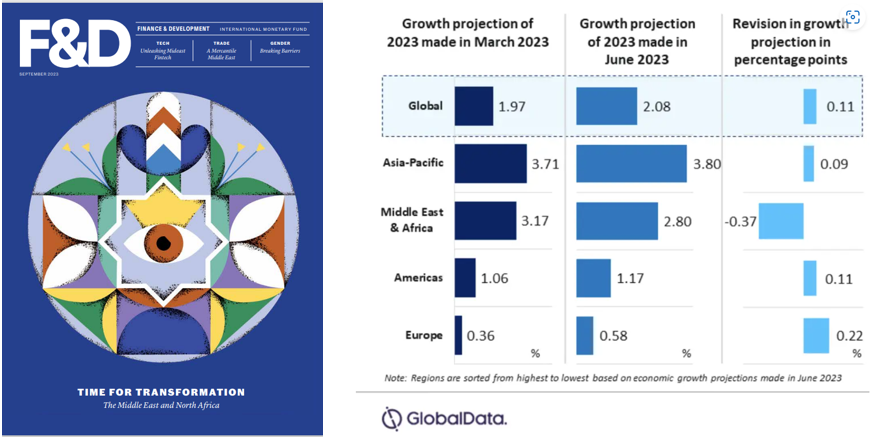
After 20 years, the IMF-World Bank Annual Meetings are returning to the Arab world. They will be held in October 2023 in Marrakech, Morocco. This seems fitting given that the Middle East and North Africa (MENA) region stands at a crossroads. In an enlightening Finance & Development blog from the International Monetary Fund (IMF), with the subject heading, "Transparent governance, economic modernization, private-sector leadership, and responsiveness to the energy transition can aid transformation," Gita Bhatt explores the challenges and potential solutions for the region's economic transformation. The blog considers how the Arab world can tap growth opportunities and rebuild its economic standing. It was heartening to read this blog from the IMF as it recognises that although the region’s challenges may be significant, so is its potential and dynamism. The blog calls this, “a critical time for bold action and creative thinking about the Arab world’s future”.
Considering the latest economic forecast data published on the growth predicted in the Middle East and Africa by the London-based data and analytics firm GlobalData, perhaps if the Region can meet these challenges of change then the Middle East is a region we should be considering investing in for growth. Indeed, the Region’s growth projection this year is set to outstrip the Americas and Europe.
Of course, in investing in the Middle East and Africa it is essential for companies to be aware of and comply with anti-corruption legislation. However, it is interesting that Transparency International's Corruption Perception Index (CPI), which ranks countries around the world, based on how corrupt their public sectors are perceived to be, the latest figures rank the UAE’s public sector only slightly more corrupt than the public sector in the USA. For context, a country with no corruption in its public sector would score 100 with the UAE scoring 67/100, slightly behind the USA’s scoring of 69/100. And while Qatar was ranked slightly more corrupt than Spain in the latest global survey Qatar is perceived as less corrupt than Italy and Poland. So, while it is crucial to establish robust compliance processes when expanding in the Middle East region, these rankings might provide some perspective and emphasize the need for caution rather than discouraging growth in the region altogether.