A sudden, unexpected increase or decrease in demand for your products or services, reduced profitability due to materials inflation, or an industry disappearing: we have always had uncertainty in our business lives, but lately, the shocks that have shaken the global economy have introduced a new level of sustained turbulence and uncertainty. We don’t know when things will return to normal – or if they will at all.
To closer track the evolution of these elevated uncertainty levels, the International Monetary Fund has updated their World Uncertainty Index to show monthly readings rather than the previous quarterly updates.
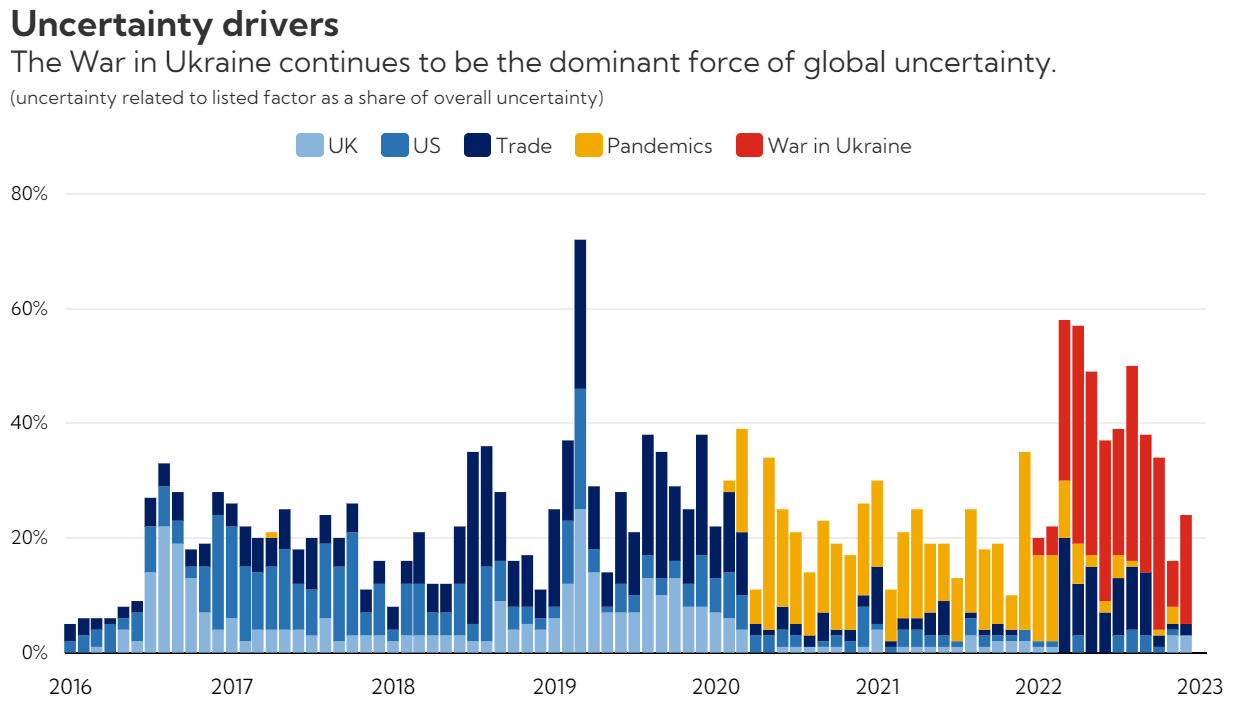
Source: Ahir, Bloom, and Furceri (2022a)
I believe that regardless of what form uncertainty comes in, it is essential to remember that we have a choice: we can either ride the wave of change or feel that it is crashing upon us as we struggle to remain afloat.
Why uncertain times are essential.
Psychologists tell us that we are all driven by six fundamental needs that are essential to our happiness: 1. Certainty, 2. Uncertainty/ variety, 3. Significance, 4. Connection/ love, 5. Growth, and 6. Contribution.
Curiously, both certainty and uncertainty top the list of these necessary conditions for happiness, even ranking higher than connection/ love. And whilst we all may instinctively accept that certainty leads to happiness, as certainty allows us to break through fear and steer our businesses toward our vision for success, we might be less open to accepting uncertainty as a necessary condition for our happiness and business success.
Certainty makes us feel good: it rewards learning, and it keeps us from wasting time overthinking. Uncertainty, however, is not something that naturally resonates with businesspeople as a prerequisite for happiness. When we think about uncertain times, many of us can feel fear, worry, and doubt. However, psychologists tell us that uncertainty – or variety – is crucial when it comes to us leading a fulfilling life. And experience tells us that times of uncertainty, whilst uncomfortable in business, can unlock new experiences and thoughts, challenging us to be innovative and creating new beliefs and strategies for the future.
A paradox of business life is this, then: business needs both certainty and uncertainty. Whilst certainty enables us to succeed in life and business, uncertainty can be a liberating and innovative force. So how do we react to these uncertain times in business becoming our own certainty?
Be your own certainty.
Life would be boring without uncertainty. So, I believe our challenge, instead of eliminating uncertainty from our business lives, is to learn how to improve the balance between certainty and uncertainty to ensure we are answering our business needs.
1. Taking responsibility
When dealing with uncertainty and changed conditions, many businesses respond by going into denial, preferring to believe that the former “good times” status quo will return. This ‘optimistic certainty’ can be attractive when turbulence comes our way. It’s the path of least resistance to believe that all will come good and watch as the events unfold and take their course. But while sitting in that place of “optimistic certainty” requires less effort, it also disempowers the business and precludes it from taking control over its own destiny. In my experience, when change happens, we rarely return to “how it was,” so we should embrace change instead of hiding from it. Uncertainty invites us as business leaders to take a hard look at any area in our business where we have a limitation and ask ourselves when we decided to accept that as certainty. For many businesses, it’s these self-imposed limitations that prevent them from making real progress. As business leaders, have we convinced ourselves that our status quo is precisely what we deserve, and we, in turn, base our business’ identity around that? I believe that if we want to thrive during uncertain times, then we must raise our standards, letting go of any limiting beliefs that keep us locked in complacency; uncertainty can be a helpful challenge to us to rise higher, making progress a “must.”
The sooner leaders take responsibility for the changed circumstances and realize action is needed, the better. If the leadership team is struggling with change, sometimes it is helpful to bring in an independent resource who can bring a fresh perspective to the organization, providing an objective view. Unencumbered by organizational politics and groupthink, an external consultant can adopt a neutral position to address challenges. This can be incredibly useful when hard and unpopular decisions need to be made.
2. Shift your focus
Uncertain times are often caused by things beyond our control: another business’ actions, a natural disaster, a war, or a pandemic. Our lack of control makes these events stressful. Attempting to control the uncontrollable leaves us feeling disempowered and anxious as our brain’s emergency fight or flight response takes over. Accepting that, just as we can’t control the weather, there are some things in business outside our control is key to dealing with uncertainty. Focusing our energy on things we can control: our emotions, plans, thoughts, and actions will leave us feeling empowered and confident instead of stressed and worried. Keeping our emotions under rational control is essential to not panicking and allowing an “amygdala hijack” to dominate our response. ‘Adaptive Engagement’ is a key resilience factor in times of uncertainty, that is: remaining flexible to changing conditions around us, leaning into what we can do and what we can control, and seeking support and help when we need it.
3. Create a vision
Creating a vision of what you truly want for your business is essential in times of uncertainty, as it can help you regain the balance that can be disrupted by uncertain times. The vision should be an image that pulls the Leadership Team emotionally toward it, not something they must be pushed towards. The most compelling vision statements excite and inspire the business by being ambitious whilst also being realistic and attainable.
In defining your business’ vision, it is important to understand your core values, passions, and strengths, then consider the impact you want to achieve. The collaborative work needed to distill this vision down to a simple, memorable statement, capturing the essence and ambition of your business itself, creates a sense of certainty. Of course, a vision is only a dream without a practical mission statement describing what you do, for whom, and how. We must be sure of our target audience, our unique value proposition, and our competitive advantage and be brave enough to regularly review and update our statements to remain aligned with our business’ evolving needs and goals.
In times of uncertainty, it is crucial that we do not go into denial of the market changes around us, always staying open to real-time feedback on the business’ performance. It is tempting to believe the former “good times” status quo will return, but this ‘optimistic certainty’ can be fool’s gold as looking back prevents us from looking forward flexibly to a new growth vision.
Conclusion
All businesses inevitably face hurdles when confronting uncertainty, but the secret to handling uncertain times is to focus on the progress we have made toward achieving our vision. If we can make progress regularly towards our goals, not allowing fear or negative self-talk to overwhelm us, setting SMART goals, and tracking our progress, then this will propel us along, helping us to push through the challenges. Celebrating our successes can bring a sense of structure and certainty to an otherwise chaotic time and uplift us as we build something new. If our vision for the new tomorrow resonates deeply within us, this will give us the strength to be our own certainty in uncertain times. A powerful, realisable vision can reinforce us with an emotional weight that gives us all the certainty we need to sail through turbulent, uncertain business waters.